Saturday, 31 January 2009

Harry Hou?


After the initial effect on Tottenham Hotspurs' fortunes which earned him the nickname Harry Houdini it appears that Harry Redknapp is fast running out of excuses and ideas.

In midweek they managed to see off Stoke City with a 3-1 victory at White Hart Lane but for anyone who saw the match it was far from a convincing performance and Stoke often exposed their defensive frailties. This was followed up today with a 3-2 defeat to Bolton Wanderers, a team that hadn't won a league match since December 20.

When Redknapp first arrived he was full of compliments for the squad he had inherited from the previous manager, Juande Ramos. Statements of intent along the line of "this squad is too good to be in the bottom half of the Premier League" and, when questioned whether he would try persuading David Beckham to White Hart Lane, "who needs Beckham when I've got (David) Bentley?" - those kind of statements, everything was 'cushty'.

The first few results suggested that Redknapp might be the right man for the job but as time has surpassed so has his memory of his initial opinions of the squad. Moaning about the squad depth and the lack of quality in certain areas of the pitch is surprising given that there are 12 regular international footballers at his disposal and a host of players on the fringe of the international stage -the likes of Tom Huddlestone, Aaron Lennon and Fraizer Campbell surely not far off.

Funny how you don't hear Tony Pulis, the Stoke manager, or Tony Mowbray, the West Bromich Albion manager, bemoaning their 'lack of squad depth'. That's because they don't throw their toys out of the pram the moment it looks like a bit of elbow grease might be needed and, above all, because they have a style of play that they stick to religiously, regardless of how unconventional it may be. The long throws at Stoke may be a bit 'route one' but they're effective and they help win games and the passing game that saw West Brom win the Coca-Cola Championship last year hasn't been altered -in fact, Mowbray went on record to say that they won't change their style of play even if it sees them lose every game.

And this is one of the many problems that Redknapp must pay close attention to. He may have the credentials to keep Spurs' afloat in the Premiership but he isn't exactly breeding confidence within his squad.

Take for instance his fierce criticism of Darren Bent following his last-minute miss against Portsmouth two weeks ago where Redknapp said: "You will never get a better chance to win a match than that. My missus could have scored that one. Bent did not only have part of the goal to aim for, but he had the entire net - and he put it wide. Unbelievable. I was just so frustrated."

Yet it was Bent who almost saved Redknapp's blushes today, scoring two after coming on as a half-time substitute which lead to Redknapp, in David Brent-like fashion, conceding that "He's (Bent) got absolutely nothing to prove to me, I know he's a good player. He was excellent today and we need him here."

Redknapp's changed his tune but only because he now knows that Jermain Defoe, the player that he made Spurs re-sign for nearly £6 million more than what they sold him to Portsmouth for 12 months ago, looks set to be on the sidelines for several weeks with a foot injury.


And with just over a day left of the transfer window it will be interesting to see who Redknapp will bring in to halt the slide that, at present, sees his side sitting in 14th and only 2 points above West Brom who are at the bottom of the league.

And when the January transfer window finally closes so will Redknapp's mouth and the endless excuses and contradictions that flow from it because Spurs are now in need of a real Houdini act, not an imitation.

Saturday, 17 January 2009

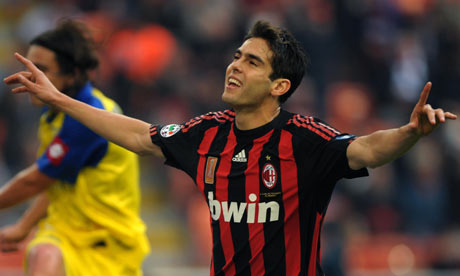
City's pursuit of Kaka could pay dividends for United


The amount of money that is being talked about in regards to the potential transfer of Kaka from AC Milan to Manchester City is hard to fathom, especially given Woolworths could have been thrown a lifeline for a fraction of the £108 million that could see the Brazilian move to Eastlands.

But according to City's manager, Mark Hughes, the deal makes "football and business sense" -a comment that would surely have raised a few eyebrows. Now you wouldn't have heard him saying that if he were still in charge at Blackburn Rovers but things have changed and now it appears that a bid in excess of £100m, with wages reported to be in the region of £500k a week, is considered normal business.

Everyone expected City to flex their financial muscle and to spend big but not to the extent that would see the previous world-record transfer fee that took Zinedine Zidane from Juventus to Real Madrid for £46m dwarfed by just over £60m. Kaka is an extremely talented footballer and one who has the undoubted technical ability to fit into the Premier League but, as many will testify, being a great player in Serie A is a completely different kettle of fish to being a great player in the Premiership.

When Manchester United bought Juan Sebastian Veron from Lazio for £28.1m in 2001 there was an air of expectation that came with the Argentinian because of his ability and status as one of the best footballers in world football at the time. However, it didn't quite go to plan for either United or Veron, who was eventually sold to Chelsea two years later. This is the huge cost that City need to wary of. Yes, Kaka is a supreme talent and he rightly earned the 2007 FIFA World Player of the Year Award but the speculated wage he would be on should he move to Eastlands would surely breed resentment, jealousy and maybe the odd pre-meditated tackle.

Of course, the same could be said of any big money transfer where there is always an evidential risk that the player could be injured in their first game and if this logic was applied before finalising each deal then there would be a shortage of big name players in the Premiership.

If City were to pull off this transfer it would draw a lot of conclusions, such as Abu Dhabi Group's seemingly bottomless well of money as well as Kaka's ambition, or lack of. But the profound effect that this transfer could have for City's fiercest rivals, United, will have Sir Alex Ferguson raising a glass of his favourite red wine - and it's not hard to see why.

Cristiano Ronaldo has just been crowned the 2008 FIFA World Player of the Year, a matter of weeks after picking up the prestigious Ballon d'Or (or European Footballer of the Year) following a mesmerising season in which he amassed 42 goals in all competitions. So if Kaka, who was the previous winner of the World Player of the Year, warrants a bid in excess of £100m then what would that make Ronaldo worth? Surely it would be more than what City would, hypothetically, pay Milan for Kaka. And given that Ronaldo is yet to recapture the form that won him universal praise last season and the continuous speculation about a move to Real Madrid, United might just be rubbing their hands at the prospect of giving their invaluable asset a price-tag.

Thursday, 15 January 2009

David Beckham: An International Treasure


David Beckham made his full debut for AC Milan on Sunday against Roma, a game in which he played 89 minutes and that ended in a 2-2 draw.

For those who doubt and continually question Beckham's worth on a football pitch, and there are a large number, here are a few statistics from the match on Sunday:
Minutes played - 89
Shots on target - 1
Shots off target - 0
Key passes - 1
Long passes - 7
Long-pass accuracy - 100%
Passes - 64
Pass completion - 84%
Crosses - 12
Cross completion - 8%
Tackles - 2
Tackles won - 100%
Fouls conceded - 1
Fouls won - 2

These, to anyone who understands statistics, are are pretty impressive considering this is Beckham's first competitive match since his season with LA Galaxy ended on 26 October. Ironically, these figures were published to run alongside a story that threw up every word and phrase in the book that suggests Beckham is no longer good enough to play football, let alone in Serie A. Perhaps the journalist didn't understand the figures or perhaps he thought that Beckham's 'long-pass accuracy' used to be 200% when he was in his 'prime'. Of course, you can't get better than 100%, but at times you'd think that you can with the level of dissatisfaction that was voiced in this particular article.


It appears that Beckham can't step onto a football pitch these days without people questioning his ability which leads to the inevitable "quit while your ahead Becks" message being relayed across all media platforms, as if they're doing him a favour. In truth Beckham has probably created more work for journalists and critics (certainly critics) than any other sporting figure in the history of sport. But what is it that annoys these people to the extent of criticising a player who, quite clearly on the above evidence, can still cut it at the top-level?


Like it or not, Beckham seems destined to equal the late, great, Bobby Moore's 108 cap landmark for England making him the second most-capped player behind Peter Shilton, who amassed 125 caps as goalkeeper between 1970 and 1990. There have been some ridiculous comments in regards to this 'issue' and one which I remember reading questioned how a 'talentless celebrity' (I think they meant Beckham rather than Jordan) could possibly be allowed to equal a record held by the inspirational Moore.


Some may disagree but Beckham was an inspirational captain and, similarly to Moore, lost a bit of public faith as captain. Let's not forget, Moore's reputation was tarnished following an arrest at the 1970 World Cup in Mexico for theft, he was later released but, so often in life, stuff like this sticks. Rightly though, Moore is remembered for what he did on the pitch and that should be the case with Beckham. It would be wrong, but so obvious, not to point out his heroic performance against Greece in which he scored a last-minute free-kick which drew the game level at 2-2 - enough to gain England automatic qualification for the 2002 World Cup. That was a true captain's performance, deputised by the superb Nigel Martyn whose own performance is so often overlooked in that match, which answered all his critics in the most dramatic way.


Beckham so often proves people wrong and overcomes his demons in such a way that objectors to him should just let him bow out on his own accord. Who can forget the barrage of abuse that he faced in his own country on his return from the '98 World Cup in which he was blamed for the nation's exit to Argentina? Burning effigies, mock dolls hung from lamp-posts with Beckham shirts on and constant booing up and down the country whenever he played for his beloved Manchester United. It's testament to the man himself that he ever wanted to captain a country that was so unrepentant in their criticism. This is a man who later faced the demons of '98 by driving home a penalty in the 2002 World Cup group stage against Argentina which all but ended their involvement in the competition.


In the said article which provoked this response, it was mentioned that Beckham "in reality" has been in decline even before he left United. Forgive me for pointing out the obvious, but Beckham left United for Real Madrid in 2003 which would have made him 27 years of age which, for an average player, would be a pretty worrying state of affairs as the following years are widely regarded as being a players' 'peak'. Similarly damning evidence (I will stop this sorry persecution of this ill-informed soul shortly -it was probably just an off-day, but then I read today's article) comes when you consider that Beckham played an influential part in Madrid winning La Liga under Fabio Capello. Beckham's professionalism was the main reason he got himself back in the starting line-up after Capello had gone on record as saying he would never play for Madrid again after it emerged that Beckham had agreed to join LA Galaxy. But this was a player supposedly in decline four years prior to this achievement.


This is somewhat refreshing, a player who is often seen as a 'prima-donna' and who could have retired years ago showing a willingness to succeed that puts most professionals to shame. Beckham has the respect of the national manager, Capello, who has labelled Beckham "a model professional" and the support of a nation, contrary to media coverage.

Whilst we seemingly have players who don't really value the pride of pulling on their nation's shirt, players like David Bentley who decided that he had more important things to do than represent the Under-21's in the U21's European Cup and players like John Terry, the England captain, and Steven Gerrard who declare themselves injured prior to an England friendly but miraculously recover in time to play for their respective clubs a few days later.

It seems that Beckham would get less stick if he decided not to turn up for an England match than having the level of pride he does in representing his country. This is a man who recognises the fact that he can still play a part for the national team and is willing to do anything to prolong his international career and if he is as amateur-ish and 'passed-it' as some would have you believe then why on earth would a club the size of AC Milan want him? Simple. They wouldn't.

Monday, 12 January 2009

Dismay in dressing room not helping Chelsea's title charge


When Luiz Felipe Scolari, or 'Big Fil' as they'll be saying on the terraces at Stamford Bridge, took over as Chelsea manager he already had a squad that most managers could only dream of assembling, they were and are, until May this year, the second best team in Europe. To think that this team have been knocked out of the Carling Cup by Championship side Burnley and forced to replay their FA Cup tie against Southend is surely, for all connected to the club, a sign of worrying times.

Add to the equation a dressing room with the likes of John Terry, the England captain, Michael Ballack, the Germany captain and Didier Drogba, the Ivory Coast captain, and you instantly have a mix of strong characters who will, inevitably, speak their mind. Indeed it has been reported that Ballack and Drogba have been the supposed protagonists of the recent dressing-room 'fall-out' having questioned Scolari's continuous inclusion of Deco, the Portuguese midfielder, despite a string of poor performances.

This is, though, merely the tip of the iceberg of the problems at Chelsea. This is a side who seemingly everyone was touting for the title before a ball was even kicked back in August, partly due to the players bought in and partly because of the new manager installed to win the silverware. Having managed a host of clubs in Brazil and the national teams of Brazil and Portugal, winning the World Cup in 2002 with Brazil, Scolari arrived in England with a glowing reputation with many predicting that he'd be the one to De-throne Sir Alex Ferguson and Manchester United's dominance.

This was back in August though and, with hindsight being the wonderful thing that it is, things clearly haven't gone to plan. In Scolari's defence, Deco started the season spectacularly with a goal on his debut against Portsmouth and scoring the only goal against Wigan with a sublime free-kick which started to justify the superlatives that were being lavished on the midfield playmaker upon his arrival. But since then Deco's performances have been ineffective and, having missed a month early in the season due to injury, his confidence has evidently dipped and his team-mates have noticed.

In addition to the players' opinions of Scolari's support of Deco there has also been reported criticisms of his use of substitutions, particularly in the 1-1 draw at home to West Ham United when some players had sarcastically reminded their manager that they were looking to win the match rather than settle for a draw having gone behind to a Craig Bellamy strike in the first half.
When there is speculation of this kind, when players are almost mocking their manager, then there is surely cause for concern. There does seem, though, to be a huge respect for Scolari and why wouldn't there be? He's a World Cup winning manager after all. But as with many players from the continent, manager's aren't immune from adjusting to the demands of the Premier League and, of course, the Chelsea owner, Roman Abramovich. And you need look no further than Avram Grant, Scolari's predecessor, who had the envious job of maintaining the high standard set by Jose Mourinho and the back-to-back league titles he won as Chelsea manager.

If the truth be told Chelsea haven't replaced Mourinho and they have subsequently struggled as both Grant and Scolari have failed to get a grip on the characters in the dressing room and have failed to channel their frustration in the right way. But the players getting on their managers back isn't helpful to either the club's title ambitions or the manager's confidence.

Sunday, 11 January 2009

A Harsh Lesson in Media for Tevez

News travels fast and that is something that Carlos Tevez, the Manchester United striker, has found out the hard way.

During a radio interview in his home country, Argentina, Tevez aired his frustration at his lack of first-team football this season with the Red Devils and suggested that he would join any club willing to offer him a serious long-term contract. These are comments which are sure to have riled his manager, Sir Alex Ferguson, who will be keen to invite his striker into his office for a private meeting.


Ferguson has had to deal with his fair share of outspoken players in his 22 year reign at the helm of United and Tevez won't be the last but, as it stands, Tevez isn't officially a United player and if he wants to be he hasn't done himself many favours.


For someone who declared his love for the club upon his loan agreement from West Ham United (or is it Kia Joorabchian?) saying that it was his "dream" to join United he has soon grown uncomfortable with the dawning reality of being United's third-choice striker behind Wayne Rooney and Dimitar Berbatov.


The comments were borne out of a mixture of frustration of falling down the pecking order at Old Trafford and the constant speculation surrounding his future. The future becoming increasingly more uncertain following the arrival of Berbatov for £30 million in the summer and the suggestion that Tevez would be an expensive substitute at a reported cost of £30m.


United fans love Tevez for the same reason they love Rooney and loved Diego Forlan, because they will run endlessly for the team. But United fans may not look on this too kindly given that at the first sign of difficulty he's become unsettled and that, according to his comments on the radio, he would be willing to sign for anyone who offers a serious contract that satisfies his long-term needs.


But time is on Tevez's side and he will surely play a part in United's assault on all league and cup fronts at this stage of the season. After a ticking off from Ferguson, it is up to Tevez to show that he is worthy of securing those long-term needs at the club of his dreams.

Sunday, 21 December 2008

Adebayor sent off as Liverpool pay for cautious approach


Liverpool missed their chance to keep themselves four points ahead of Chelsea at the top of the Premier League with a 1-1 draw against Arsenal at the Emirates.

Despite maintaining their lead at the summit of the Premiership, Chelsea could leapfrog them if they beat Everton at Goodison tomorrow evening.

In a relatively tight contest between these two sides, a draw was probably a fair result if not expected- this being the fourth draw in Liverpool's last five league games.

Arsenal, having gone ahead in the 24th minute through a superbly taken goal by Robin Van Persie were pegged back thanks to a mixture of slack defending and great anticipation which saw the much-maligned Robbie Keane rifle an unstoppable half-volley past Manuel Almunia, the Arsenal goalkeeper.

The game only really came to light when Emanuel Adebayor, the Arsenal striker, was given his marching orders for a second bookable offence which Howard Webb, the match official, deemed a dangerous tackle on Liverpool's Alvaro Arbeloa. This further weakened an Arsenal side who were forced to substitute their captain, Cesc Fabregas, at the interval following a strong challenge from Xabi Alonso seconds before the half-time whistle was blown.


Liverpool failed to make the most of their numerical advantage and were far too cautious in going forward which is a weakness which could blight their title challenge. With this draw becoming the fourth of their last five league games Rafael Benitez, the Liverpool manager, will be increasingly alarmed at his sides inability to finish off opponents. Much was made of the way in which Liverpool responded in salvaging a draw after falling two goals behind to Hull City at Anfield, yet the very fact that they found themselves trailing at home to the Premier League new-boys would surely have been of paramount concern to the Liverpool boss.

Every campaign throws up strange results and points will inevitably lost but the likes of West Ham United, Hull and Fulham are the type of games that Benitez would be hoping to take maximum points from when in reality they have only managed three points from these three games. The huge positive for Liverpool at this moment in time is that lady luck is shining on them and has been for the best part of the season as the 'big four' of Arsenal, Chelsea and Manchester United have all failed to take advantage of any situation presented to them.

Chelsea could go a point clear with a win at Everton tomorrow and United will be in buoyant mood as they arrive back as World Champions and safe in the knowledge that they have two games in hand in which to claw their way back to the top of the league. Liverpool will need to start making their own luck if they are to avoid the second-half of their season becoming a repeat of this afternoon's second-half performance.

Saturday, 20 December 2008

The Managerial Disease


This week Paul Ince became the eighteenth manager to have lost his job this season following a set of poor results that has left Blackburn Rovers second from bottom in the Premier League.

Much has been made of the support, or lack of, that Ince and other young managers receive and the short time with which they are provided to make an impact.
At one time or another this season, in the Premier League especially, there has always been a spotlight on at least one manager at any one time. At the very start of the season it was Alan Curbishley at West Ham United and Kevin Keegan at Newcastle United, they both left as a result of diminished responsibility (not the legal term) with team affairs.

Only last week, as a result of mounting pressure, Roy Keane left his post as Sunderland manager following a string of below-par results. The baffling thing with this though is the fact that it was Keane who, ultimately, became the victim of his own success as it was the standard that he set to which these 'below-par' performances could be compared. Much was made of the amount of money he had spent since his arrival, in the region of £80 million, and the fiscal angle is one which always attracts a fair bit of scrutiny. It cannot be ignored that Sunderland were not playing as well as they had been but the swiftness of the media to focus the spotlight on any manager showing a glimmer of under-achievement puts undue pressure on club management to act upon this.

It is a sad indictment of the state of the beautiful game when new managers are given what appears to be a two-game bedding in period and managers with a proven track record are overlooked for hire because of one poor stint somewhere down the line.

Take Tony Adams, the Portsmouth manager, who after narrowly losing 1-0 to Liverpool at Anfield in his first match in charge, found himself under pressure when he lost his second game at home to Wigan 2-1. Although no side is guaranteed their place in the Premier League, it would be a surprise if Portsmouth found themselves in the relegation 'dog-fight' come April given the foundations that Harry Redknapp, their former manager, had built at the club. With regular internationals in the squad and a reported £20 million bid from Real Madrid for their midfielder Lassana Diarra, Adams will have some money to start shaping his own squad.

It should be noted that since them winning the Premier League in the 1994/95 season, Blackburn Rovers have tasted little success. The fan base at Ewood Park isn't huge and if there was a real possibility of them being relegated to the Championship they have all the ingredients of becoming the next Charlton Athletic. Ince, although having the same squad that finished 7th in the league last season under Mark Hughes, never really replaced David Bentley who was an influential player for Rovers last term. He was also unfortunate in that Roque Santa Cruz, their main goal threat, was absent through injury for most of his reign as boss.

The main concern now is that Ince will contract the English disease that blights managers who show promise but who are, ultimately, remembered for what is, in simple terms, a blip but in managerial and media terms as a disaster.

One key example of this is Sam Allardyce who coincidentally has been linked with both vacancies at the Stadium of Light and Ewood Park. Allardyce is a manager with a proven track record from plying his trade at Limerick, in the League of Ireland, in which he topped the league in his first season in charge. After brief stints at Preston North End and Blackpool, he then won promotion at the first attempt by finishing top of Division Three at the end of the 1997-98 season with Notts County, breaking several club and national records in the process, subsequently winning the title by a 19-point margin and becoming the first post-war side to win promotion in mid-March.

He then went on to become manager of Bolton Wanderers and gained promotion to the Premier League in his second season after a 3-0 win over Preston in the play-off final. He, with the help of the chairman, Phil Gartside, made Bolton into a stable Premiership club - later leading them into the UEFA Cup. But if asked today if Allardyce is the man for the job, people would probably scoff. Why? Probably because he tried to make Newcastle United into a successful team but failed where plenty others have too.


On the continent managers are given chance after chance to prove themselves and they usually ply there trade at lower league clubs before moving on to the bigger clubs. The likes of Rafa Bentiez, Arsene Wenger and even Juande Ramos are examples of this approach and they come here with a well-earned reputation.

This is the route that Ince was prepared to take, but the questionable motives behind his appointment and the lack of managerial experience cost him and, sadly, he won't be remembered for his achievements at Macclesfield and MK Dons.